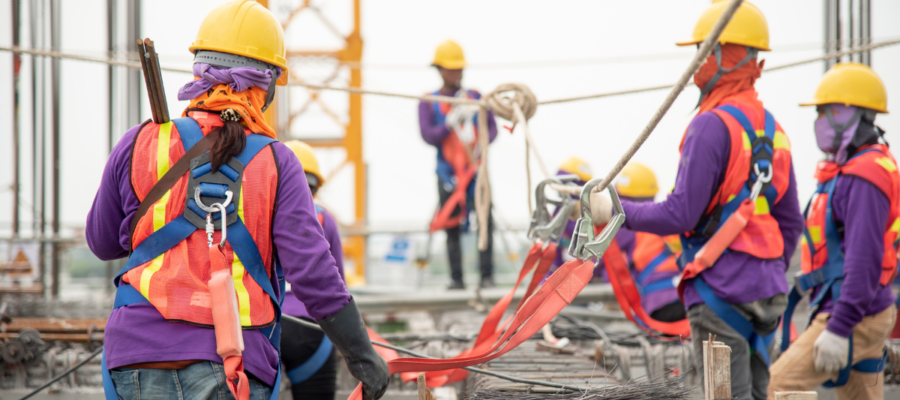





On a construction site, personal protective equipment, commonly referred to as PPE—is the final level of defense against occupational risks. Falls from height, spills, crashes, electrical contacts: each risk calls for specific, approved and properly worn equipment. This guide provides an update on the essential PPE, the standards to know and best practices for using them effectively.
What is security PPE?
Personal protective equipment is any device intended to be worn or held by a person for the purpose of protecting that person from one or more hazards likely to threaten their safety or health. European regulation 2016/425 governs their design, certification and placing on the market.
The PPE comes in addition to collective protections—guardrails, nets, barriers—and not in their place. They cover residual risks that collective measures cannot fully eliminate.
The mandatory PPE on site
The head protection: the construction helmet
The helmet is basic PPE on any worksite. It protects against falling objects, impacts against fixed elements and projections. It must comply with EN 397 and be suitable for the working environment—some models include electrical protection or resistance to extreme temperatures.
A helmet that is cracked, deformed, or too old must be replaced without delay, even if it has never received any visible impact.
Foot protection: safety shoes
Safety shoes protect against crushing, punctures, and slipping. They come in several categories depending on the level of protection:
S1: safety tip, antistatic
S2: S1 + water penetration resistance
S3: S2 + puncture resistant sole
The reference standard is EN ISO 20345. In construction, level S3 is the recommended standard for most sites.
Hand protection: work gloves
Hands are the most exposed members to injuries on site. The choice of gloves directly depends on the type of risk:
Cut-resistant gloves (EN 388) for handling sharp materials
Thermal gloves for work with a flame or in contact with hot surfaces
Insulating gloves for interventions near electrical installations
An inadequate glove is as dangerous as a lack of one: it distorts the perception of risk without offering the expected protection.
Eye and face protection
Concrete projections, fragments, dust, welding radiation: eye risks are omnipresent in the construction industry. Available amenities include:
Protective goggles (EN 166) for particle projections
Face masks for grinding or cutting jobs
Welding screens with filters adapted to the intensity of the arc
Fall protection: the fall arrest harness
For all work at height not collectively protected, the fall arrest harness is mandatory. It must comply with standard EN 361 and be used with an approved lanyard or reel connected to a certified anchorage point EN 795.
Wearing a harness is not enough: the user must know the rescue procedures in case of inert suspension, a dangerous situation that can occur within minutes.
Respiratory protection
On construction sites generating toxic dust, fumes, or vapors—asbestos, crystalline silica, solvents—adequate respiratory protection is essential:
FFP2 mask for fine dust
FFP3 Mask for asbestos fibers and very fine dust
Half mask with filter for chemical vapors
Visibility: the high-visibility vest
On any work site near machinery or traffic lanes, a high-visibility vest class 2 or 3 (EN ISO 20471) is required. It allows operators to be immediately spotted, significantly reducing the risk of collisions.
How to choose your PIE
Identify risks in advance: before choosing a PIE, an analysis of the risks specific to the workstation is essential. Each PPE must respond to an identified risk, not be chosen out of habit or by default.
Check the CE marking and standards: all PPE placed on the market in Europe must bear the CE marking accompanied by the number of the notified body for category II and III PPE. The applicable EN standards are listed on the product leaflet.
Adapt the PPE to the user: a poorly adjusted PPE is ineffective PPE. Size, morphology, climatic conditions all these parameters influence the choice of model and must be taken into account during selection.
Check PPE compatibility: helmet with visor, harness with work clothing—some combinations may reduce the effectiveness of each piece of equipment separately. The manufacturer’s instructions specify the compatibilities to be respected.
Best practices for wearing your PPE
Inspect the equipment before each use: tear, crack, worn strap—any defect must lead to immediate removal of PPE
Store PPE properly: away from heat, moisture, and chemicals
Stick to lifespan: each PPE has a expiration date or the maximum number of cycles specified by the manufacturer
Train in the use: harness, breathing apparatus insulating some PPE require specific training before use
Related Posts