



Everything you need to know about mandatory personal protective equipment (PPE): their essential role in preventing occupational hazards and ensuring the safety of field teams.
Discover the standards in force that guarantee the quality, compliance and efficiency of equipment used in different work environments.
On a construction site, danger is omnipresent: falls from heights, splashes, excessive noise, electrical or chemical hazards. In the face of these risks, Personal Protective Equipment (PPE) is the last line of defense between the worker and the accident.
Yet, their use remains too often neglected or poorly controlled. At Alchary we believe that security is not a constraint—it’s an investment. This article guides you through the essentials you need to know about PPE being developed in 2025.
40%
serious workplace accidents could have been avoided with appropriate PPE
#1
The construction industry is the most accident-prone sector in terms of fatal accidents.
3
categories of PPE defined by European regulations
1. Why is PPE mandatory on site?
Personal Protective Equipment (PPE) are devices or means intended to be worn or held by a person in order to protect them against one or more risks likely to threaten their health or safety.
Their mandatory nature is based on several fundamental texts:
* The Labor Code (Articles L.4321-1 et seq.) requires the employer to provide the necessary PPE free of charge.
* The European directive 89/656/EEC provides a framework for minimum safety requirements.
* European regulation EU 2016/425 defines design and certification requirements.
⚠️ Prevention Principle
PPE is used as a last resort, after all collective prevention measures have been applied (collective protection, work organization, training). They do not replace—they complete.
2. The main types of on-site PPE
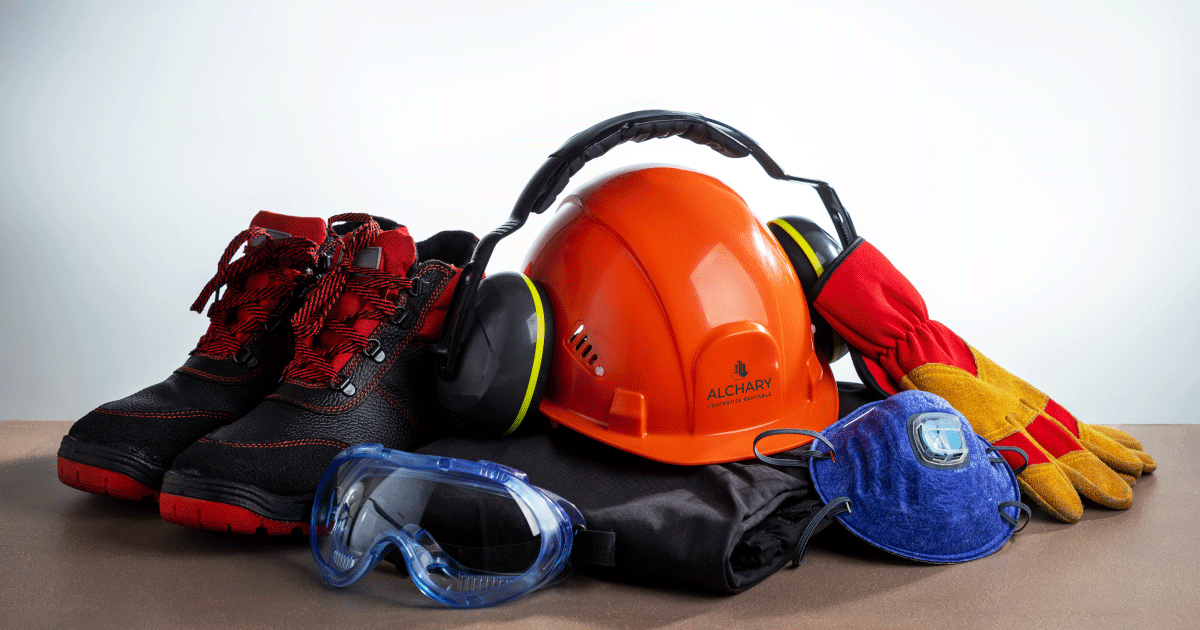
Each type of risk on the construction site corresponds to a specific piece of equipment. Here are the essential PPE in the construction industry:
Construction Helmet
Protection against falling objects, bumps and splashes. Mandatory on all sites.
Safety shoes
Steel or composite toe cap, puncture-resistant and slip-resistant sole. Foot protection against crushing.
Protective gloves
Adapted to the risk: cut, chemical, thermal, or vibration. The right glove at the right position.
High-visibility clothing
Vest or class 2 or 3 clothing for worksites near traffic lanes.
Goggles / protective mask
Eye protection against splashes, dust, UV light, or chemicals.
Hearing protectors
Earplugs or ear muffs are mandatory from 85 dB(A). Prevention of occupational deafness.
Safety harness
Essential for all work at height. Includes certified harness, lanyard, and anchor point.
Respiratory Mask
Filtration of dusts (silica, asbestos) or chemical vapors depending on the type of filter.
3. Current standards and regulations
In Europe and countries that apply international standards, all PPE must be certified according to current standards. Here’s what to check:
CE marking
All PPE sold in Europe must be marked with the CE Marking certifying its compliance with EU Regulation 2016/425. This marking shall be accompanied by the number of the notified body which has checked the equipment.
The 3 categories of PIE
Category I: Minimal risks (sunglasses, light duty gloves). Manufacturer self-certification.
Category II: Intermediate risks (helmets, work gloves, safety shoes). Mandatory EC type examination.
Category III: Deadly or irreversible risks (harnesses, asbestos masks, fall arrest equipment). Permanent inspection by notified body.
The use of PPE without a valid CE marking exposes the employer to criminal sanctions and invalidates any coverage in case of workplace accident. Never skip the certification.
4. How to choose your PPE wisely?
The choice of a PIE is not random. It is based on a rigorous assessment of the risks specific to each workstation. Here is the recommended method:
Identify job risks — falls, noise, splashes, chemicals, crushing, etc.
Consult the Single Risk Assessment Document (DUER) — it lists risks by work unit.
Choose the appropriate PPE for the risk level — verify the category and specific standards for each piece of equipment.
Ensuring ergonomics and comfort — uncomfortable PPE is unworn PPE. The worker’s tolerance is an essential criterion.
Verify PPE compatibility a headset may interfere with a hearing protector or glasses. Test the combinations.
Train workers on proper use — worn PPE does not protect.
5. Maintenance and lifespan of PPE
Damaged or expired PPE can be as dangerous as no protection. Life cycle management of every piece of equipment is a legal requirement and an operational priority.
General Maintenance Rules
All PPE sold in Europe must be marked with the CE Marking certifying its compliance with EU Regulation 2016/425. This marking shall be accompanied by the number of the notified body which has checked the equipment.
General Maintenance Rules
- Clean PPE after each use according to the manufacturer’s instructions.
- Store in a dry place, away from heat and UV light.
- Inspect visually before each use (cracks, tears, deformation).
- Never repair a Grade III PPE yourself—replace it immediately.
Indicative lifetimes
- 🪖 Helmet: 3 to 5 years (or immediately after a crash)
- 👟 Safety shoes: 1 to 3 years depending on use
- 🪢 Fall arrest harness: 10 years maximum, to be removed immediately after a fall
- 😷 Disposable mask (FFP2/FFP3): single use only
- 🧤 Gloves: according to visual wear and technical data sheet
Set up a PPE tracking log for each worker. Record the commissioning date, periodic inspections and replacement date. This is proof of your commitment in the event of a control or incident.
6. Employer legal obligations
The law is clear: the responsibility for providing PPE lies exclusively with the employer. Here are his primary obligations:
Provide the necessary PPE free of charge to each employee at risk.
Ensuring the effective wearing of PPE on site—responsibility persists even if the employee refuses to wear it.
Train and inform workers about the risks and proper use of PPE.
Ensure the regular replacement of used or expired PPE, at no cost to the employee.
Consult staff representatives (CSE) when choosing PPE.
Failure to comply with these obligations may result in an inexcusable fault by the employer, with severe financial and criminal consequences, particularly in the event of a serious or fatal accident.
7. Conclusion: Security is a profitable investment
Personal Protective Equipment is not an expense—it’s an investment in your company’s human capital. A site where teams feel protected is one where productivity, quality, and reputation improve.
Security is non-negotiable. Protect your men, protect your business.
Related Posts