



How to optimize safety on a structural work site?
Structural work remains one of the most accident-prone phases in the construction industry. Foundations, earthworks, lifting, formwork, work at height: each stage exposes teams to major risks. However, a large part of these accidents could be avoided thanks to rigorous organization and appropriate prevention measures. In this article, we review the specific risks associated with structural work sites and the concrete levers for optimizing site safety, from the regulatory framework to the most recent digital tools
Why safety is a major issue on structural work sites
The building and public works sector is among those most exposed to workplace accidents. Structural work phases account for a significant share of serious claims: falls from heights, crashes, electrocutions or accidents related to lifting equipment.
Beyond the human impact, the consequences of a construction site accident are manifold for a company:
• Human consequences: work stoppages, after-effects, sometimes death.
• Legal consequences: questioning the civil and criminal liability of the project owner and the intervening companies.
• Financial consequences: site closure, increase in AT/MP contributions, contractual penalties.
• Consequences on reputation: difficulty winning new markets, loss of trust from clients and partners.
Optimizing safety is therefore not just a regulatory obligation: it is a real driver of performance and sustainability for the company.
The main risks on a structural work site
Height drops
As the leading cause of serious accidents in the construction industry, falls from height occur during work on scaffolding, roofing, under construction floors, or unprotected hoppers.
The risks related to vehicles and traffic
Cranes, excavators, truck rotors, and cherry pickers often share the same space as workers on foot. The intersection between vehicles and pedestrians is one of the main causes of collisions on site.
The risks of handling and lifting
Lifting heavy loads (benches, reinforcements, prefabricated elements) exposes the risk of load drop, tipping or crushing in case of faulty slant or poorly defined maneuvering area.
Electrical and collapse risks
Contact with underground or aerial networks, as well as the risk of collapse of trenches or unscreened excavations, are among the hazards specific to foundation and earthworks work.
The risks related to coactivity
On a structural work site, several companies often operate simultaneously. This coactivity multiplies the interfaces at risk if coordination is not anticipated.
The regulatory framework to be aware of
Before talking about optimization, let’s recall the regulatory bases that structure prevention on a structural work site in France:
• The Single Risk Assessment Document (DUER): mandatory for all companies, it identifies occupational risks and associated prevention measures.
• The PPSPS (Special Safety and Health Protection Plan): a document drafted by each company involved in projects subject to SPS coordination.
• The SPS coordinator (Safety and Health Protection): designated by the project owner as soon as there is cooperation between companies, he harmonizes prevention measures among the various stakeholders.
• The Labor Code: it notably requires the provision of appropriate personal protective equipment (PPE) and the training of employees in the risks associated with their jobs.
A good understanding of this regulatory framework is the essential foundation before any continuous improvement approach.
8 concrete levers to optimize site safety
1. Perform a rigorous risk assessment beforehand
It all starts before the construction site opens. A detailed analysis of the risks specific to each phase (earthworks, foundations, elevation of structures) makes it possible to anticipate preventive measures rather than suffer them.
2. Continuously train and raise awareness among teams
The training must not be limited to the first day’s security welcome. Regular security quarters, reminders on gestures and postures, awareness of the specific risks of each task: repetition anchors good reflexes.
3. Provide and control PPE port
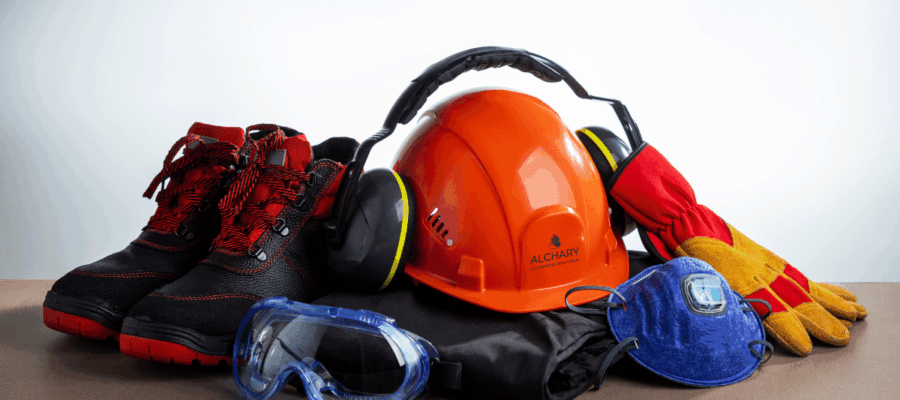
Helmets, safety shoes, fall arrest harnesses, gloves, and goggles must be adapted to each workstation. Beyond supply, it is the regular monitoring of the effective wearing of PPE that makes the difference on the ground.
4. Organize and mark the worksite
A clear traffic plan, visible signage, and physical separation between pedestrian and vehicle zones significantly reduce the risk of collisions.
5. Secure work at height
Guardrails, safety nets, verified scaffolding, and harnesses connected to approved anchor points are essential. Each access at height must be checked before use.
6. Supervise lifting and handling operations
Delimitation of lifting areas, verification of slings, training of crane operators and shunting supervisors, prohibition of heavy traffic: these simple rules strongly limit incidents related to lifting.
7. Set up regular inspections and audits
Scheduled safety visits, combined with unannounced audits, help detect deviations before they turn into an accident. These inspections must be followed by documented corrective actions.
8. Digitize security tracking
Safety checklist applications, IoT sensors on machines, connected badges for access control, or even inspection drones: digital tools now allow real-time monitoring of safety conditions on the site, with enhanced traceability.
The key role of the work supervisor and SPS coordinator
The construction manager is the primary guarantor of the application of daily safety measures. He leads the teams, ensures compliance with procedures, and reports anomalies. At the same time, the SPS coordinator plays an arbitration role between companies, ensuring that the interfaces between trades do not create uncontrolled risk areas. The complementarity between these two functions is often what distinguishes a well-managed site from an exposed one.
Building a real safety culture on the worksite
Beyond technical and regulatory devices, sustainable safety optimization relies on the company’s safety culture. This goes through:
• The exemplary nature of management, which must apply the rules it imposes.
• Valuing safe behaviors rather than simply penalizing deviations.
• The involvement of teams in escalating risky situations (right of withdrawal, facilitated reporting).
• A regular dialogue between the various trades present on site.
Truly optimized safety is never static: it adjusts continuously, site after site, feedback after feedback.
Frequently Asked Questions
What is the main risk on a structural work site?
Falls from heights remain the leading cause of serious accidents, followed by risks related to equipment and lifting loads.
Who is responsible for safety on a structural work site?
Responsibility is shared: each company is responsible for the safety of its employees, while the SPS coordinator ensures consistency in measures among the various stakeholders.
What documents are mandatory for the safety of a construction site?
The Single Risk Assessment Document (DUER) and, in case of coactivity, each company’s PPSPS as well as the General Coordination Plan drawn up by the SPS coordinator.
Conclusion
Optimizing safety on a structural work site requires a comprehensive approach: knowledge of risks, compliance with the regulatory framework, ongoing training for teams, rigorous site organization, and, increasingly, use of digital monitoring tools. Companies that make security a true pillar of their corporate culture benefit from it doubly: the protection of their teams and sustainably improved operational performance.
Related Posts