
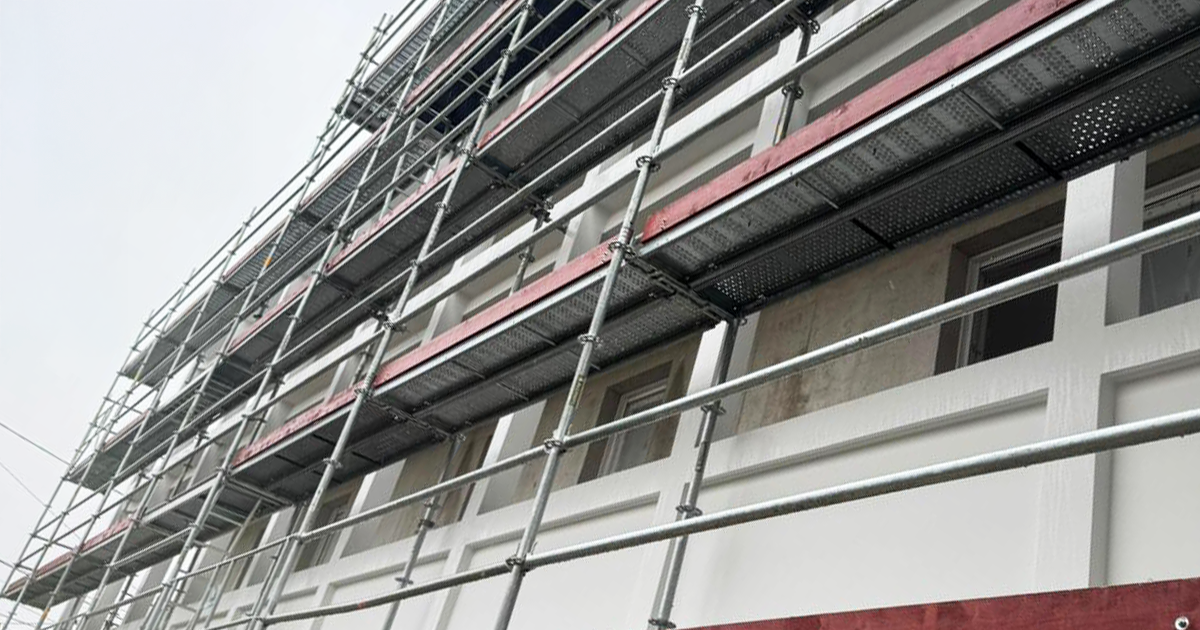
Scaffolding anchorage is an essential step in the implementation of a secure scaffolding. It consists of securely attaching the structure to the building in order to ensure its stability against various external constraints. Although often invisible, anchorage plays a decisive role in the prevention of accidents and the durability of the installation.
Unanchored or loose scaffolding can quickly become dangerous. Under the effect of wind, the weight of workers or vibrations related to work, the structure can move, deform, or even collapse. That is why scaffolding anchorage is considered an obligation on the majority of professional sites.
Why is scaffolding anchorage essential?
A scaffolding is a temporary structure exposed to constant forces. The wind exerts significant pressure, especially at height, which can cause a tipping if the structure is not properly fixed. To this is added the weight of materials, tools and workers, which generates a permanent vertical load.
Anchoring thus stabilizes the scaffolding by connecting it directly to a solid support, usually the building facade. This connection prevents lateral movements and ensures a better distribution of efforts. According to the recommendations of INRS, anchoring is essential for securing work at height and reducing the risk of accident.
How does scaffolding anchoring work?
The principle of scaffolding anchorage is based on a mechanical connection between the structure and the bearing wall. This fixation is generally done using dowels, metal rods or sealing systems adapted to the type of support.
In this system, the mooring tube plays a central role. It allows the scaffolding to be connected to the anchor point fixed in the facade, thus ensuring the stability of the whole.
The quality of the medium remains a determining factor. A solid concrete wall offers excellent resistance, while a hollow or degraded wall requires specific solutions such as chemical anchors.
The different types of scaffolding anchorage
There are several types of scaffolding anchorage, each adapted to specific situations. Rigid anchorage is the most common. It offers a direct fixation without movement, ideal for heavy structures or areas exposed to wind.
The flexible anchor, on the other hand, allows for slight movement of the structure. It is used to absorb certain stresses, particularly related to wind gusts, and avoid overloading the attachment points.
Finally, through anchoring involves attaching a rod through the wall to achieve maximum strength. This solution is particularly used when the loads are significant or when the support is fragile.
The rules to follow for effective anchoring
To ensure reliable scaffolding anchorage, it is essential to follow certain technical rules. The anchor points must be evenly distributed over the entire height of the structure in order to ensure homogeneous stability.
The choice of fastenings must always be adapted to the nature of the support. It is also essential to check the condition of the wall before any installation, because a degraded support can compromise the entire system.
Safety requirements are governed by standards such as NF EN 12811, which define the performance and strength criteria for scaffolding on construction sites.
Common errors to avoid
In practice, many incidents are related to anchoring errors. The lack of fastening remains the most serious error, especially on small construction sites where safety rules are sometimes neglected.
The use of unsuitable fasteners is also a common problem. Poor compatibility between the ankle and the support can lead to rapid tearing off.
Too much spacing between anchor points greatly reduces overall stability. Finally, the lack of control after installation is a critical error. A simple tensile test, however, allows for checking the strength of the fixings.
Conclusion
Scaffolding anchorage is a fundamental element to ensure the safety and stability of a construction site. It allows to resist the efforts of the wind, to support the loads and to ensure a reliable use of the structure.
A well-anchored scaffolding protects workers, secures the construction site and ensures compliance with standards. Conversely, a neglected anchorage represents a major risk.
Investing in a good anchoring system, and especially in essential components such as the mooring tube, is therefore essential for any building professional.
Related Posts