



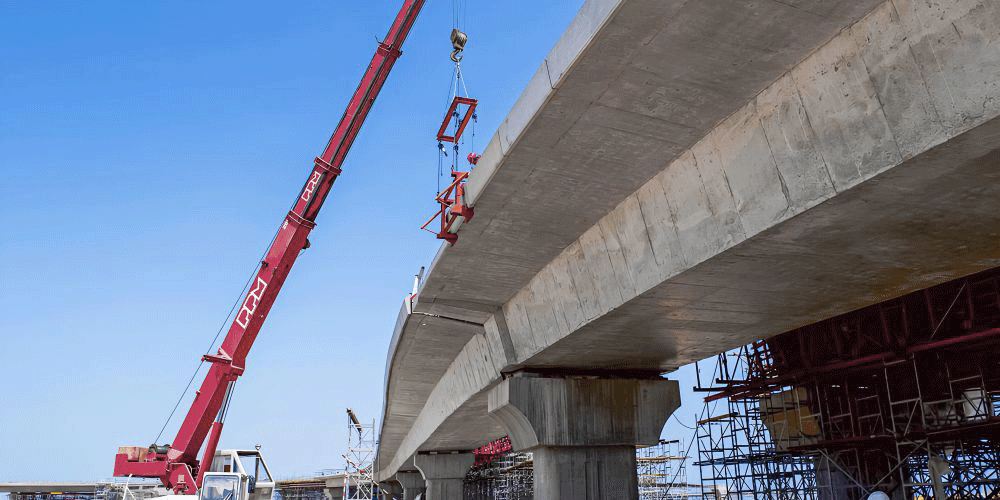
Project Description
The Radès–La Goulette Bridge is one of Tunisia’s most iconic and strategic infrastructure projects. Serving as a vital link between the southern and northern suburbs of Greater Tunis, it spans the Tunis Lake canal and acts as a key artery for regional mobility and economic development.
As the first extradosed cable-stayed bridge built in Tunisia—and on the African continent—the structure stands out for its contemporary architecture and high-level technical performance. Opened in 2009, it plays a crucial role in improving traffic flow and relieving congestion on the capital’s main thoroughfares.
The main bridge, spanning 260 meters, rests on two pylons over 45 meters high and comprises three spans measuring 70 m, 120 m, and 70 m. Situated nearly 20 meters above sea level, it crosses the shipping channel while ensuring the continuity of surrounding road and rail networks.
Conceived as a strategic asset, the Radès–La Goulette Bridge facilitates connections between the southern, western, and northern regions of Tunis while improving access to the port, industrial, and logistics zones of Radès and La Goulette. It thereby contributes to boosting economic competitiveness and optimizing travel within Greater Tunis.
Constructing the bridge required advanced engineering solutions to address the geotechnical challenges posed by highly compressible lacustrine soil. The deep foundations—reaching depths of up to 80 meters—and the construction techniques employed demonstrate the high level of expertise brought to this major project. The result of Tunisian-Japanese cooperation, this structure was built with the participation of international companies specializing in major infrastructure and civil engineering projects, making the Radès–La Goulette Bridge a major benchmark for large-scale structural engineering in Tunisia.
