

Scaffolding is an indispensable tool in the building sector. Two systems dominate the market: frame scaffolding and multidirectional scaffolding. Although they meet the same need for work at heights, they have significant differences. To choose well, it is essential to understand their characteristics.
What is a framework scaffolding?
Frame scaffolding, often called facade scaffolding, is designed for work on flat surfaces. It consists of metal frames connected by crosspieces and diagonals. Its main strength lies in its simplicity. Its assembly is fast and does not require a very specialized workforce. It is also an economical solution, ideal for renovation projects or construction of straight facades. However, its lack of flexibility limits its use in complex structures.
What is multidirectional scaffolding?
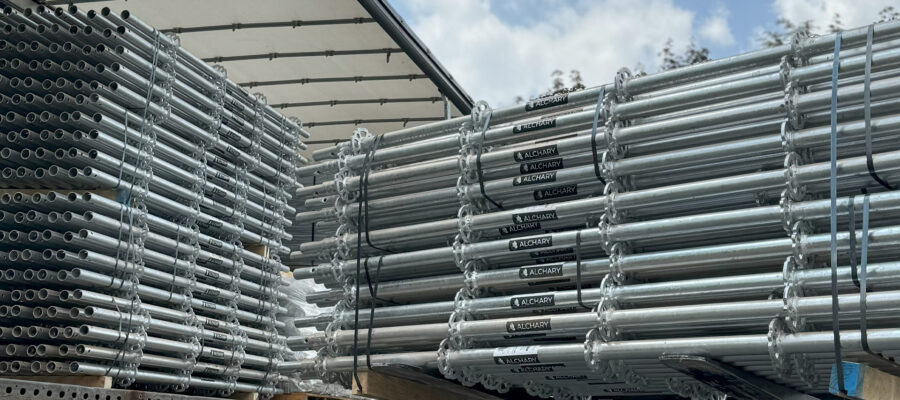
The multidirectional scaffolding is distinguished by its modularity. It uses a system of rosette knots that allows the elements to be fixed in several directions. This design makes it perfect for construction sites with irregular shapes or complex structures such as bridges, frameworks or towers. It offers great stability and superior strength. On the other hand, its assembly is more technical and requires trained teams. Its cost is also higher, but it guarantees maximum adaptability.
The main differences between the two systems
The first difference concerns flexibility. The framework scaffolding is suitable for simple facades, while the multidirectional scaffolding is essential on complex sites. The speed of assembly is another criterion: the frame is quickly assembled, whereas the multidirectional requires more time and expertise. Finally, the cost varies. The framework remains more economical, while the multidirectional represents a larger investment, justified by its versatility.
Which scaffolding to choose for your construction site?
The choice depends on the nature of the construction site. For simple works on a straight facade, the framework scaffolding is sufficient. For projects requiring a complex structure and particular configurations, it is better to opt for a multidirectional scaffolding. Before any decision, analyze the site configuration, safety standards, and available budget.
Tips for optimal use
For optimal and safe use of the scaffolding, carefully plan the assembly to reduce installation time and prevent errors. Make sure the ground is stable and level to avoid instability. Use only compatible components, without mixing brands, to preserve the strength of the structure. Systematically install collective protections (guardrails, baseboards, floors) before use, to prevent falls. Finally, regularly check the condition of the parts and remove those that are damaged to ensure the safety and durability of the scaffolding.
Choosing between a frame scaffolding and a multi-directional scaffolding depends primarily on the complexity of your construction site. For simple structures, the frame remains efficient and economical, while for projects requiring modularity and safety, multidirectional scaffolding is the ideal solution. Good preparation and compliance with safety rules will ensure the success of your work. Discover our complete line of multidirectional scaffolding for all your complex projects.
usage
Related Posts